
Customer Care Team
Equal Access Language Services
Customer Care Team
Hi there
How can I help you today?
How can I help you today?

Start Whatsapp Chat


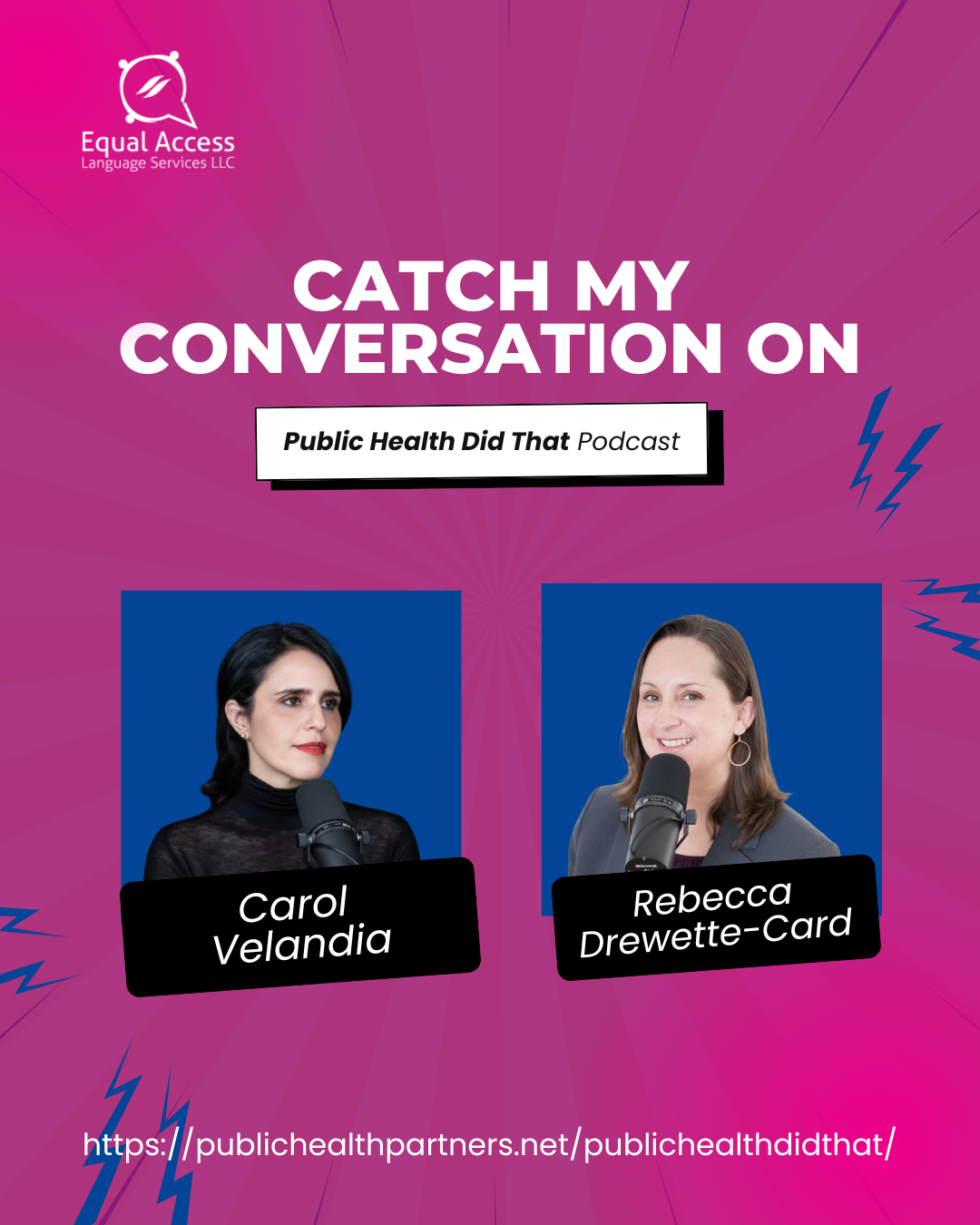
At Equal Access Language Services, we often say that language access is not a service. It is a right. It is also the foundation of inclusion. Our founder and CEO, Carol Velandia, recently joined Rebecca Drewette-Card, from the Public Health Did That podcast to talk about why language access matters, how it shapes health outcomes, and what needs to change so every person can receive care with dignity.
This episode gave us a chance to share the reason our work exists. It also gave us an opportunity to highlight the barriers that many of our fellow countrymen face every day. Below is a deeper look into what Carol shared and why this conversation matters so much for public health and healthcare.
Carol began the episode by explaining why she founded Equal Access Language Services in 2017. As a longtime interpreter in one of Maryland's largest hospitals and as an immigrant herself, she experienced the language barrier from both sides.
She saw patients waiting months for a visit because an interpreter was not scheduled. She saw families misunderstand care plans. She saw avoidable delays, fear, and frustration. She saw that language based discrimination was not abstract. It affected health in real and direct ways.
Today more than 25 million people in the United States do not speak English. That number alone should make language access a priority. Yet in practice, it is often treated as an afterthought. Carol created Equal Access Language Services so that organizations can ensure their services are accessible for people with limited English proficiency and people who are deaf or hard of hearing. Her goal is simple: make language access the cornerstone of inclusion.
During the conversation, Carol shared a story that shaped her commitment to this work. While interpreting for a patient from Central America, she heard about his journey to the United States, the trauma he endured, and the gratitude he felt once an interpreter was finally scheduled for him.
But despite this gratitude, his health had already worsened because his original appointment had been postponed for months. Not scheduling an interpreter for his first appointment r caused a delay that placed him at greater risk. That moment made it clear that the language barrier is not just a communication issue. It is a public health issue. We cannot expect equity in care if patients cannot understand or be understood.
Equal Access Language Services provides translation and interpretation in spoken languages and American Sign Language. But that is only one part of our mission.
Carol talked about the need to shift the way we think about language barriers. A language barrier is the same as a physical barrier. Just as ramps allow entry into a building, interpreters and translated materials allow entry into systems of care. Stairs are not bad. English is not bad. But ramps are necessary. Language access is the ramp.
To support this shift, Carol developed a course titled Effective Inclusion Through Language Access. The course helps healthcare professionals learn about linguistic diversity, the history of multilingualism in the United States, the impact of miscommunication on health outcomes, and the requirements of federal law. It also offers up to ten continuing education units. The goal is to make language access part of planning and operations, not an optional fix.
Carol shared that there is growing awareness about the importance of language access. More providers and public health teams understand how language shapes care, trust, and outcomes. Yet recent political shifts have also increased stigma toward those who do not speak English or who speak English with an accent.
This environment makes the work more urgent. It requires clear guidance, compassionate outreach, and systems that treat language access as a requirement rather than a courtesy.
When asked about her favorite part of her work, Carol said that it is the moment when people begin to see language barriers through a new lens. When they recall a time they were in a country where no one spoke their language. When they imagine what it would feel like to be sick and unable to communicate. This shift builds compassion, and compassion strengthens care.
At Equal Access Language Services, we believe that connection can change systems. When someone understands the impact of the language barrier, they begin to design services differently. They start planning for inclusion instead of scrambling to correct exclusion.
Support begins with unlearning and re-learning how linguistic barriers and accessibility shape people’s experiences. It starts by reconnecting with your code of ethics and committing to the elimination of language barriers. Working with professional interpreters and professional translators is an essential first step.
The work continues with the development of meaningful language access plans and the training of healthcare teams. It deepens when organizational leaders recognize language access as integral to quality of care, patient safety, and equity.
Organizations interested in learning more about the Effective Inclusion Through Language Access course are invited to connect with us through our website.
Hear Carol's full discussion with Public Health Did That and learn why language access must be a public health priority.
Listen to the episode here
Reach out to us at info@equalaccesslanguageservices.com
.webp)
.webp)
.webp)


