
Customer Care Team
Equal Access Language Services
Customer Care Team
Hi there
How can I help you today?
How can I help you today?

Start Whatsapp Chat


.webp)
A New Role for Language Services Providers in the Fight for Language Rights
In October 2023, MultiLingual magazine published my article “A New Role for Language Services Providers,” which challenged LSPs to embrace a moral imperative: to become active agents of inclusion, not just providers of services. That article was personal. I wrote it not just as a professional in the language services industry, but as someone who has repeatedly witnessed the deep injustice that results when people are denied their right to be understood.
Now, only 15 months later, what was a warning has become a crisis. Executive Order 14224, signed on March 1, 2025, repealed Executive Order 13166 and declared English as the official language of federal agencies. In doing so, it stripped away protections that millions of people relied on to access healthcare, justice, education, and basic benefits and services. It is not a law or a regulation and cannot be enforced in any court, but Executive Order 14224 is erasing our multilingual identity and is a direct assault on long-standing civil rights.
Such an action demands a response, not just from policymakers, but from all of us.
We Knew This Was Coming, sort of…
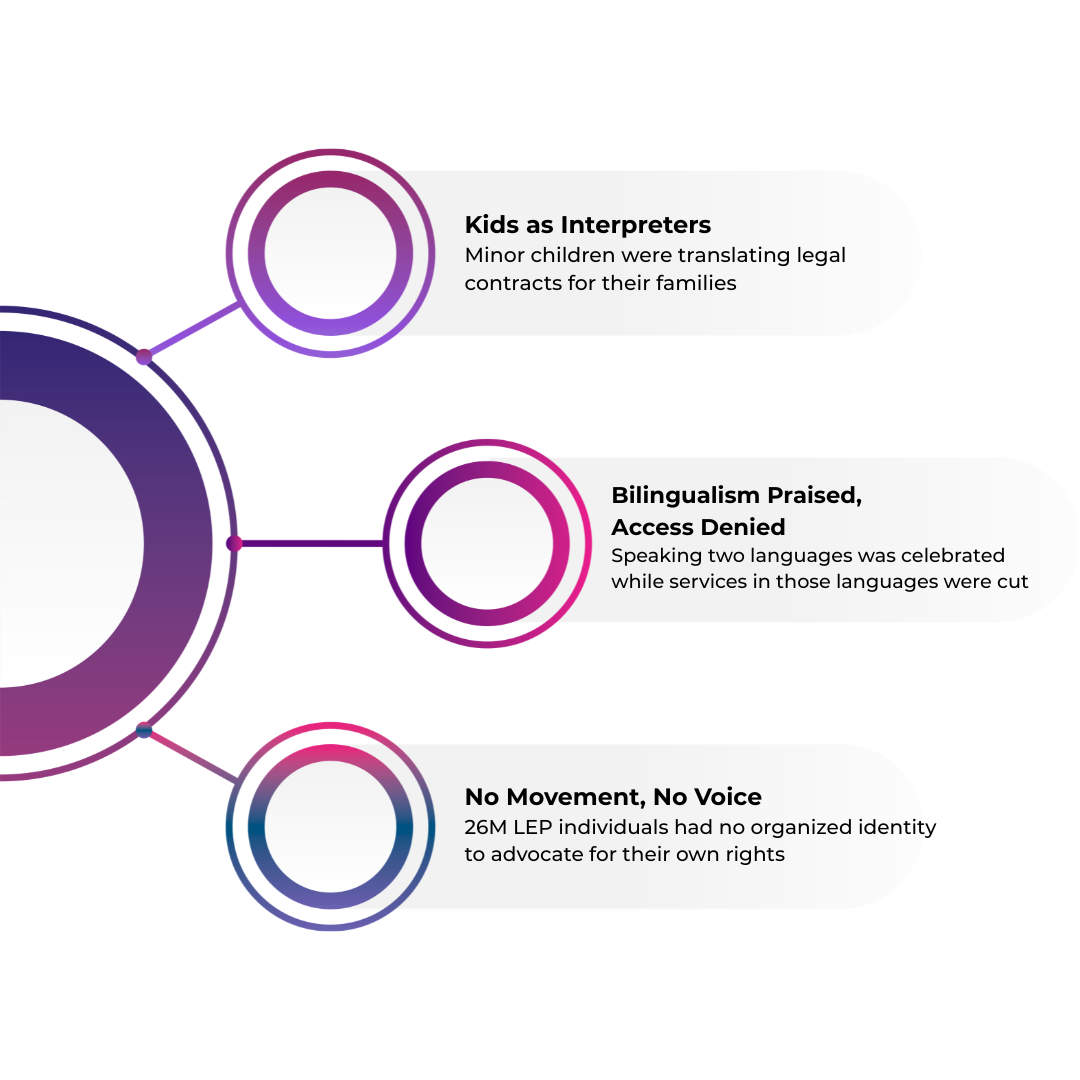
My 2023 article warned that language discrimination was being normalized is several ways:
And now, with EO 14224 in place, the consequences are clear: without stronger legal protections at the federal, state and local level, individuals with limited English proficiency (LEP) will fall through the cracks of every critical institution in American life.
I didn’t begin my journey as an advocate. I started out, like many of you, as an interpreter focused on the mechanics of communication, the craft of language, the precision of meaning. I believed in the power of words, but for a long time, I didn’t see myself as someone who could shape policy or change minds at scale.
That changed the first time I attended Language Advocacy Day in Washington D.C., organized by JNCL-NCLIS. I arrived eager, passionate, and prepared to advocate for the people I served every day, those who navigate our systems without English fluency, who are so often overlooked in Diversity, Equity, and Inclusion (DEI) initiatives. But, instead of a voice for them, what I heard was… silence.
The advocates around me were brilliant, but only focused on protecting foreign language education and global learning programs. No one was talking about the 26 million LEP individuals in our country whose lives and liberties are in jeopardy when interpreters are not present in hospitals, courtrooms, or schools. These 26 million voices were absent from the conversations in Washington D.C., as they often are in DEI initiatives, where language is routinely treated as a footnote to intersectionality rather than a central axis of access. (And now, of course, DEI has become taboo, multilingualism branded un-American, and “inclusion” dismissed as a radical idea.) No one in that room was asking for federal investment in language access. I remember being surrounded by powerful voices who understood the value of learning languages, but not the leap between being bilingual and being a professional interpreter. They didn’t see how critical our profession is to making equity and inclusion real. I felt invisible. But I wasn’t discouraged. My voice as an advocate was not extinguished. Instead, it was ignited.
Finding My Voice—and a Community
Upon joining the Association of Language Companies (ALC) and participating in their advocacy day since its inception in 2020, I've observed an evolution. In recent years, under the incredible leadership of advocates like our colleague Bill Rivers, we've more openly addressed language access, aligning discussions with the core of our profession. In that virtual room, advocating for the language industry and language access, for the first time, I didn’t feel like a lone voice. I felt like I was part of a movement.
In March 2024 and in our most recent On the Hill advocacy day, ALC advocacy efforts achieved the following:
We must amplify this emphasis and consider advocating for comprehensive federal language access legislation, like the Americans with Disabilities Act, a law that enshrines language access as a fundamental right.
It might seem counterintuitive to do this in the current political landscape, where anything that seems to promote inclusion, equity, or diversity has been demonized, anything that underscores the immigrants and slaves who created the foundation and the very essence of the United States, paradoxically, seems unamerican. Like the colonists facing a tyrannical ruler who was restricting people’s “unalienable rights,” this is the moment to advocate for people’s language rights.
In MultiLingual’s April 2025 issue, there was was an interview with Michael Mulé from the U.S. Department of Justice. He reminded us that Title VI of the Civil Rights Act of 1964 requires all federally funded programs to provide meaningful access to people with LEP. These aren’t suggestions. They’re legal mandates grounded in our national values.
Mulé's warning is especially urgent now. EO14224 does not reference Title VI or similar laws, because it cannot undo the protections those civil rights laws created for every person in the United States, no matter what language they speak. EO 14224 doesn't just repeal EO 13166, It symbolically declares that English is the only language that matters. It signals to millions of people: “If you can't speak English, you don't belong here.”
That message is un-American.
And it is unacceptable.
While EO 14224 targets U.S. protections, language injustice is not confined to any one nation. Worldwide, linguistic minorities face systemic exclusion:
As the global language industry surpasses $75 billion, it is unconscionable that we remain on the sidelines of this global equity crisis.
We are the only profession whose entire purpose is to break barriers. And we have realized that the largest barriers, are not those of language but narrow mindedness, and exclusionary policies. We need to continue to challenge policies that undermine effective communication, access, and inclusion.
I’ve heard from so many in our field: “I don’t want to get political.” But language access is not politics, it’s people, culture, and identity. It’s ethics. It’s survival. Now is the time to publicly oppose EO 14224 and all efforts to roll back language rights. Let’s show the world that we are not just vendors, we are defenders.
LSPs, particularly those operating in the United States, should issue formal statements opposing the repeal of EO 13166 and the establishment of English-only policies. Silence may be interpreted as acquiescence; therefore, it is imperative to articulate a clear stance. While EO 14224 does not explicitly prohibit language access services, its symbolic impact can lead to the erosion of language rights. Drawing from the parable of the frog in gradually heated water, we must recognize and respond to incremental threats before they culminate in irreversible consequences. This is not about fear-mongering but about demonstrating the courage to confront injustice and uphold our professional integrity. Public opposition underscores the industry's commitment to linguistic diversity and the rights of people with LEP.
Many stakeholders, including public service professionals such as doctors, nurses, educators, pharmacists, and social workers, may be unaware of the protections that have been rescinded. LSPs must proactively fill this informational void by providing clear guidance and practical solutions grounded in ethics and equity. This responsibility extends to independent interpreters, who should inform LEP individuals of their longstanding right to effective communication in public services. By becoming authoritative sources on language access, we empower our clients and communities to navigate these changes effectively.
It's crucial to recognize that many public service professionals already have ethical obligations to communicate effectively with the communities they serve:
While federal agency policies may be shifting, state and local governments must follow Title VI and related laws and can enact measures to protect language access. LSPs should collaborate with advocacy groups to promote legislation that upholds and expands language services at state and regional levels. Engaging with policymakers, participating in public forums, and supporting grassroots initiatives can influence positive change.
The enactment of EO 14224 serves as a wake-up call for the global language industry. LSPs must collaborate with international organizations, human rights bodies, and governments to establish and enforce comprehensive language access standards. By elevating this issue to the global stage, we can work towards policies that transcend national boundaries and uphold the rights of linguistic minorities worldwide.
Article 2 of the 1948 Universal Declaration of Human Rights explains how “[e]veryone is entitled to all the rights and freedoms [in the Declaration]…without distinction of any kind, such as race, colour, sex, [or] language…” Now, almost 80 years later, isn’t it time for a Language Access International Standard?
We must transition from being perceived solely as service providers to being recognized as pivotal defenders of human rights. This shift involves actively challenging policies that undermine effective communication, access, and inclusion. By embracing this expanded role, we affirm our commitment to breaking down barriers, not just linguistic ones, but also those rooted in discrimination, prejudice, and exclusion. We are not passive facilitators of communication. We are the front line of human rights. Let us act like it.
When I first founded my company, Equal Access Language Services, I wasn’t sure how to talk about justice and profit in the same breath. But I’ve learned they are not opposites. Helping clients see the ROI of language access—through reduced liability, better customer experience, and broader market reach—is one of the most strategic moves any business can make.
And if that’s what gets them to invest? Great. Let them come for the compliance—and stay for the compassion.
.png)
The original article concluded with an invitation: to do good, not just do business. In 2025, that invitation becomes a directive.
We must no longer see ourselves as vendors of services. We must be guardians of comprehension, defenders of dignity, and champions of inclusion. Because if we don’t fight for the right to understand and be understood, who will?
EO 14224 must not be the end of the story. It must be the beginning of better and stronger laws.
Let this be our turning point.
Let this be the moment that Language Access became a movement.
.webp)
.webp)


